Most teams start with a familiar question:
How do we add AI to our product?
That question sounds practical, but it usually leads to bolt-on features and short-lived wins.
A better question is this:
What does the system look like when AI is part of the operating model?
AI is not a plugin. It changes how software should be designed, built, and run.
Three levels of adoption
Most teams move through three stages.
1. AI as a feature
Examples:
- chatbot added to an existing app
- copilot embedded in a specific screen
- one workflow automated using an LLM API
This creates value, but AI is still isolated from core system behavior.
2. AI-enabled systems
Examples:
- APIs redesigned for AI-triggered interactions
- retrieval pipelines built for context-aware responses
- LLM reasoning integrated into business workflows
This is a stronger architecture, but many flows are still manually initiated by humans.
3. AI-native systems
Examples:
- agents make bounded decisions under policy
- workflow routing adapts based on runtime context
- orchestration handles tasks that cannot be fully predefined
At this stage, AI is not a sidecar. It becomes part of the runtime model.
The operating model shift
The key shift is not just model quality. It is how execution happens.
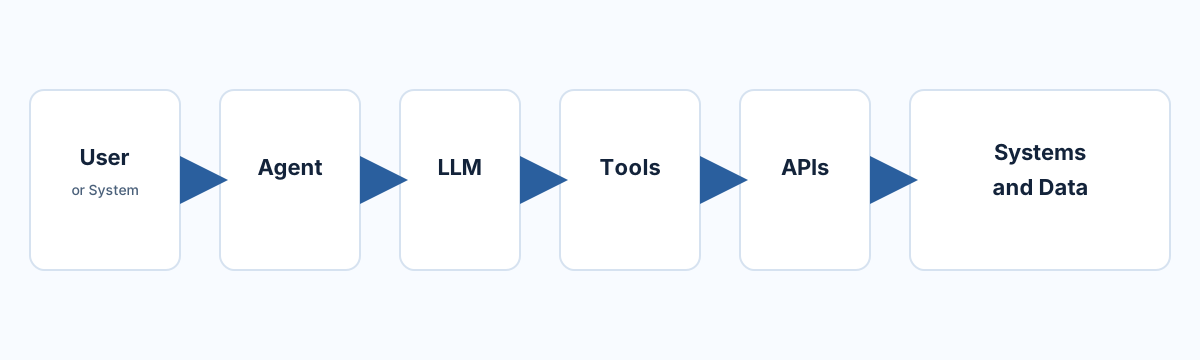
In practical terms:
- APIs become machine-first contracts, not only UI backends.
- Retrieval is a runtime capability, not an afterthought.
- Agents are execution logic, not chat wrappers.
- Tools are action boundaries that connect reasoning to real systems.
What already exists vs what teams must build
Most foundational pieces are available today:
- strong LLMs
- agent frameworks
- vector stores and retrieval infrastructure
- cloud primitives
What teams still need to design well:
- durable API contracts
- data pipelines and ownership boundaries
- orchestration and policy controls
- governance and observability
This is where most delivery risk sits.
Why teams get stuck
The same failure modes appear repeatedly:
- weak or inconsistent APIs
- no clear data strategy for retrieval quality
- overengineering before production feedback
- missing observability across agent, tool, and system boundaries
These are engineering system problems, not prompt problems.
A practical rollout path
A safer and faster sequence works for most teams:
- Make the current system AI-ready (APIs, telemetry, guardrails).
- Add retrieval where context quality drives decision quality.
- Introduce agents for bounded, high-value workflows.
- Scale gradually with strict runtime feedback and controls.
This sequence keeps risk controlled while proving measurable value.
Production proof points
An AI workflow is not production-ready because the answer looks good in a demo. It is ready when the surrounding system can explain what happened and recover when a step fails.
Useful signals include:
- task completion rate, not just model response rate
- tool-call failures, retries, and timeout frequency
- human overrides and the reasons they were needed
- retrieval quality for the records that influenced a decision
- latency and cost across the complete workflow
These signals create a feedback loop for improving prompts, tools, data, and policy together. Without them, teams cannot tell whether a problem came from the model or from the system around it.
Where AI should remain a feature
Not every workflow needs agents or adaptive orchestration. A deterministic workflow is usually better when the rules are stable, the inputs are structured, and the cost of variation is high.
The goal is not to make every system AI-native. It is to identify where context, ambiguity, or changing conditions make fixed logic insufficient, then introduce AI inside clear operating boundaries.
Final thought
AI does not replace systems. It changes system behavior.
Teams that win will be the ones that design for AI as part of architecture, execution, and operations from day one.
If you are planning this transition, start with system readiness before model experimentation.