Most AI roadmaps fail for one reason:
teams try to add AI without redesigning the system around it.
That produces impressive demos and fragile operations.
The hard truth
If AI is just a feature, you get local optimization:
- one chatbot
- one copilot
- one automated step
Useful, but limited.
If AI is part of the system model, you get compounding leverage:
- agents executing bounded decisions
- runtime context retrieval instead of static logic
- workflows that adapt under policy
What changes in architecture
The execution chain is now machine-first:
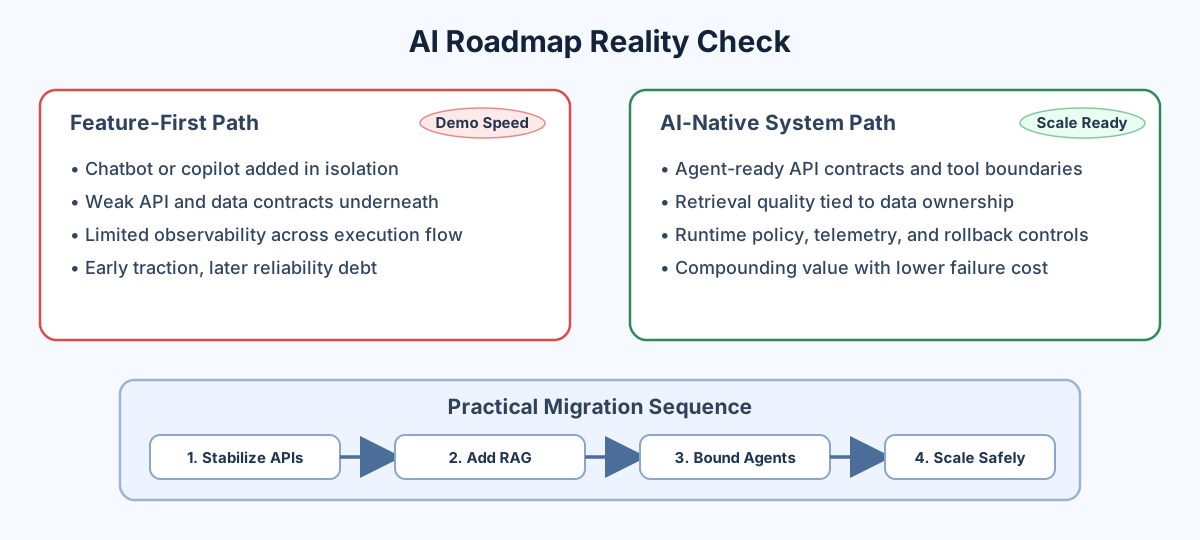
This means:
- APIs are contracts for agents, not only frontends.
- Data pipelines must support retrieval quality, not just reporting.
- Tool boundaries must be explicit, secure, and observable.
- Orchestration becomes a first-class engineering concern.
Where leadership teams misread risk
Common mistakes:
- assuming model choice is the main differentiator
- underinvesting in API quality and data ownership
- scaling complexity before proving operational feedback loops
- treating observability as a phase-two task
These are system design failures, not AI failures.
Practical playbook
- Stabilize APIs, telemetry, and policy controls.
- Add RAG where decision quality depends on context.
- Introduce agents in bounded workflows with clear rollback paths.
- Scale only after reliability signals are real in production.
Questions leadership should require answers to
Before approving a broader rollout, leadership should be able to answer:
- Which decisions can the system make without approval?
- Which tools and records can it access?
- What happens when retrieval is incomplete or contradictory?
- Can an operator reconstruct why an action was taken?
- What is the rollback path when a workflow behaves incorrectly?
These questions turn governance into system design. They also expose whether a pilot has a credible path to production or is still dependent on careful demonstration conditions.
Where to stay conventional
If a workflow is predictable, high-volume, and fully expressible as rules, conventional automation may remain the safer and cheaper option. AI earns its place where it improves decisions under ambiguity, not where it merely replaces code that was already deterministic.
Final point
AI will not replace your systems.
It will expose whether your systems were designed to evolve.
Teams that build AI-native operating models now will move faster and break less later.