Challenge
Environmental review workbooks combined project data, discipline-specific rules, measures, calculations, and formal report formatting in one place.
Approach
Separated reviewer workflow, structured data, domain rules, and document generation using Power Apps, Dataverse, and Power BI Paginated Reports.
Outcome
Established a common environmental reporting platform where workflow, structured data, domain rules, and document presentation can evolve independently.
Engagement snapshot
Environmental review workflow, shared Dataverse data modeling, discipline-specific configuration and rules, and formal document generation across Biological, Water, and Cultural Resources reporting.
- Shared foundation
- Common review data in Dataverse
- Configured variation
- A reusable reviewer workflow
- Formal reporting
- Controlled document generation
Projects, structures, reviews, inputs, and measures became reusable platform concepts across environmental disciplines.
Report types retain their own inputs, applicable measures, and domain rules within a shared application foundation.
Power BI Paginated Reports preserve repeatable final layouts while business rules progressively move out of RDL definitions.
Environmental review teams relied on sophisticated Excel workbooks to prepare formal reports across multiple disciplines. The workbooks held project inputs, structures, environmental measures, formulas, lookup data, and parts of the final reporting logic.
Kindl Labs helped transform this process into a configuration-driven reporting platform using Power Apps, Dataverse, and Power BI Paginated Reports. The architecture separates workflow, structured data, domain rules, and document generation, allowing environmental report types to share a platform while retaining their discipline-specific behaviour.
Challenge
Excel combined project and structure information, reviewer inputs, standard and selected measures, calculated values, GIS-derived information, narrative logic, and final document formatting. Understanding the domain and its rules was the first challenge.
Biological, Water, and Cultural Resources reports share projects / TDs, structures, reviews, report types, inputs, measures, review status, and final report generation. Each discipline also has its own inputs and business rules. Separate applications and data models for every report type would preserve the fragmentation of the original workbooks.
Approach
The solution separates four responsibilities.
01 — Workflow
A Canvas Power App guides reviewers through project / TD selection, report type, structures, inputs, measures, review and preview, and final report generation. The application foundation supports multiple environmental disciplines through a shared reviewer workflow.
02 — Structured Data
Dataverse provides the common environmental review model: projects, report types, reviews and versions, structures, input definitions, review inputs, common and selected measures, report-specific data, and GIS-related information. Business data is maintained independently of the user interface and report definition.
03 — Domain Rules
Configuration and domain logic determine the inputs and measures available to each report type. Mandatory measures cannot be removed by reviewers. GIS information, derived values, and narrative inputs can affect processing differently by discipline.
Business rules are progressively moved out of RDL report definitions. Paginated Reports consume an authoritative reporting model, with domain behaviour maintained outside the document layout.
04 — Document Generation
Power BI Paginated Reports produce the controlled final layout. This preserves the precise, repeatable formatting required for formal environmental reports while the review workflow and data model evolve.
Configuration-Driven Design
Project and report-type selection, structures, review/version management, inputs, measures, preview, and report generation form the shared platform. Configuration and domain rules supply the variations for Biological, Water, and Cultural Resources reports.
This common model supports discipline-specific requirements without duplicating the complete application. Additional report types can progressively extend the configuration, data, and rules within the same architecture.
Engineering Decisions
Don’t rebuild Excel. The workbooks provided evidence of the domain and its rules. The replacement architecture was organized around those responsibilities.
Model the common domain. Projects, structures, reviews, inputs, and measures became reusable platform concepts.
Separate rules from presentation. Business rules progressively move out of report definitions, leaving RDL primarily responsible for document rendering.
Configure variation. Biological, Water, and Cultural Resources share the platform while retaining their own inputs, measures, and rules.
Preserve formal reporting. Paginated Reports retain the controlled document layout required by environmental reporting.
Design for expansion. New disciplines should increasingly require extensions to configuration, data, and domain rules within the existing application foundation.
Solution Architecture
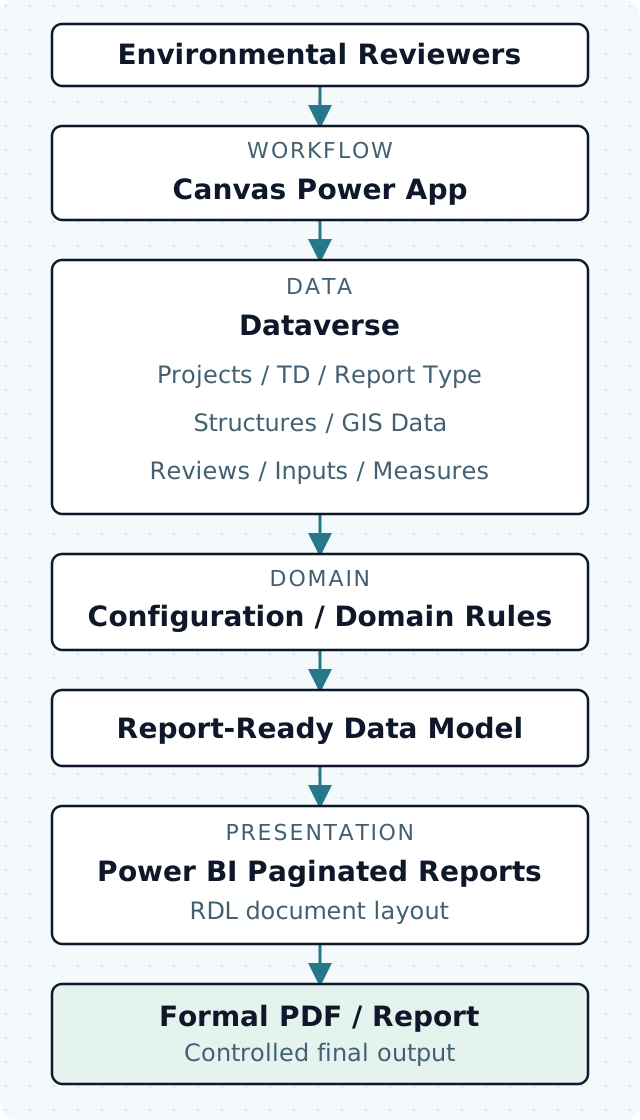
The responsibility boundaries are workflow in Power Apps, data in Dataverse, domain behaviour in configuration and business rules, and presentation in Paginated Reports. The reporting model connects the domain to the final document without exposing internal schemas or confidential rules.
Outcome
The result is a reusable environmental reporting platform with:
- Structured Power Platform review processes replacing spreadsheet-centric workflows.
- Dataverse as the common foundation for environmental review data.
- A reusable reviewer experience across multiple disciplines, with configured inputs and measures.
- Separate responsibilities for workflow, data, domain rules, and document presentation.
- Formal report generation through Power BI Paginated Reports.
- Reduced dependence on rules embedded in spreadsheets and report definitions, with further rules extraction progressing within the architecture.
- A foundation for additional environmental report types without duplicating the complete application.
Instead of rebuilding each environmental workbook as a separate application, the solution established a common reporting platform where workflow, structured data, domain rules and document presentation can evolve independently.
Technologies
- Microsoft Power Platform
- Power Apps
- Dataverse
- Power BI
- Power BI Paginated Reports
- RDL
- Power Fx
- Power Automate
- Data Modeling
- Configuration-Driven Architecture
From proof to your next decision
See the capability demonstrated in this engagement and the thinking behind the approach.
Architecture & Technical Guidance
Clear technical direction for systems that need to scale, evolve, or recover.
Explore the service Related perspectiveWhy Most Modernization Projects Struggle (And What Actually Works)
Modernization struggles usually start before implementation. Controlled evolution, data-first planning, and stronger DevOps consistently work better than full rewrites.
Read the insightDiscuss a similar challenge with the team behind our architecture & technical guidance work.
Start a conversation