Challenge
Complex Oracle-based indirect tax workflow with major performance bottlenecks and multi-system integration overhead.
Approach
Reworked the integration flow around batching, concurrency, cache-first retrieval, and transformation standardization.
Outcome
Internal optimization runs moved processing from multi-hour projections to sub-hour execution, with later tuned runs reaching roughly 15 minutes end-to-end.
Engagement snapshot
Performance-critical redesign of an Oracle-centred indirect-tax integration supporting both batch and on-demand processing.
- Early observed pace
- 561 transactions in about 30 minutes
- Intermediate run
- 4,685 transactions in just over 45 minutes
- Later tuned run
- Approximately 15 minutes end-to-end
Project notes indicated a roughly five-hour full-run projection at this processing rate.
Observed after reducing the fiscal-code dependency in the critical path.
Reported internal optimization run after batching, caching, concurrency, and logging changes; not an external benchmark.
Challenge
A US-based FinTech company needed to improve a complex indirect tax processing workflow built around Oracle Finance systems and external tax services.
The integration landscape involved:
- Oracle Fusion using SOAP/XML services
- Oracle BIP for report-driven fiscal code retrieval
- Oracle UCM for file handling and output upload
- JSON-based tax service endpoints
- Both batch and on-demand execution paths
The major business and technical problems were:
-
Performance bottlenecks: Fiscal code retrieval through SOAP/BIP introduced high latency. In the earlier model, requests were handled too narrowly and too often, creating significant delays for large files.
-
Sequential processing limits: Too much of the workload was processed consecutively instead of concurrently, reducing throughput for high-volume runs.
-
Batch SLA risk: Observed runs projected several hours to completion in some scenarios, which was not acceptable operationally.
-
Integration complexity: The system had to bridge SOAP/XML Oracle interactions with JSON tax APIs, while preserving correctness in both directions and supporting the full processing loop.
-
Operational issues: The platform needed stronger controls for retries, logging, batch status, cache usage, memory pressure, and observability.
Approach
Kindl Labs focused on the performance-critical part of the integration flow and reworked the solution around batching, concurrency, caching, and safer operational controls.
The engineering approach included:
-
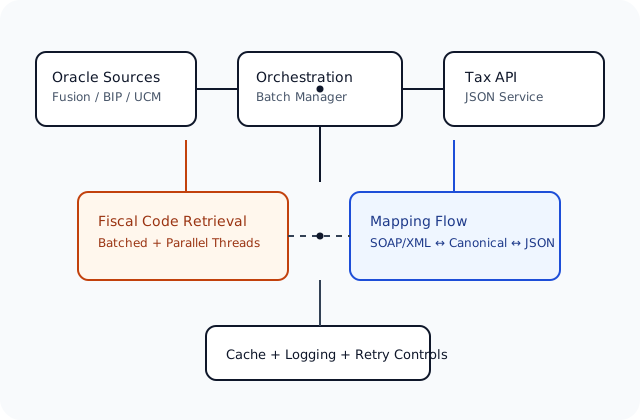
Isolate the primary bottleneck: Analysis showed the fiscal code retrieval path was a major source of delay, so it became the optimization target.
-
Introduce batch-oriented fiscal code retrieval: The design moved from narrow per-transaction behavior toward grouped batch retrieval before mapping.
-
Add concurrency and parallel execution: Parallel threads allowed multiple fiscal code retrieval requests to run concurrently during batch processing.
-
Add cache-first lookup behavior: The mapping flow reused already-retrieved fiscal data and called the source again only on cache miss.
-
Keep on-demand and batch behavior aligned: The solution supported both real-time on-demand flows and large batch processing.
-
Reduce operational overhead: Logging levels and flow behavior were tuned to lower runtime cost while preserving auditability and troubleshooting coverage.
Solution Architecture
This architecture was redesigned to keep fiscal-code retrieval, transformation, and tax-service calls coordinated while improving throughput and control.
                        +-----------------------------------+
                        |         Oracle Source Files       |
                        |      CSV / ZIP / Batch Input      |
                        +----------------+------------------+
                                         |
                                         v
                        +-----------------------------------+
                        |   ERP Integration Service Manager |
                        |  Batch Control / Orchestration    |
                        +----------------+------------------+
                                         |
                 +-----------------------+------------------------+
                 |                                                |
                 v                                                v
+-----------------------------------+          +-----------------------------------+
|   Fiscal Code Retrieval Pipeline  |          |      Transaction Mapping Flow     |
|  Oracle BIP SOAP/XML Requests     |          |   SOAP/XML <-> Canonical <-> JSON |
|  Batch IDs + Parallel Threads     |          |   Request/Response Transformation |
+----------------+------------------+          +----------------+------------------+
                 |                                                |
                 v                                                v
+-----------------------------------+          +-----------------------------------+
| Cache / Temporary In-Memory Store |          |     JSON Tax Service Endpoints    |
| Cache-first lookup during mapping |          |     Tax Calculation / Response     |
+----------------+------------------+          +----------------+------------------+
                 |                                                |
                 +-----------------------+------------------------+
                                         |
                                         v
                        +-----------------------------------+
                        |   Result Processing / Comments    |
                        |   Output Preparation              |
                        +----------------+------------------+
                                         |
                                         v
                        +-----------------------------------+
                        |        Oracle UCM Upload          |
                        |     Final Response / Closure      |
                        +----------------+------------------+
                                         |
                                         v
                        +-----------------------------------+
                        | Logging / Monitoring / Retry Flow |
                        | Batch Status / Failure Handling   |
                        +-----------------------------------+
Outcome
The project delivered a more scalable and performance-focused integration flow for indirect tax processing.
Documented and observed performance evolution from project notes:
- Early runs showed roughly 561 transactions in about 30 minutes, implying around 5 hours for full completion at that pace.
- A later observed state processed around 4,685 transactions in just over 45 minutes when fiscal code dependency was reduced in the critical path.
- Further optimization work, including caching and reduced logging overhead, brought end-to-end completion to about 45 minutes.
- In later tuned internal runs, the process was reported to complete in roughly 15 minutes end-to-end.
Practical business impact:
- Processing moved from multi-hour risk windows toward much faster batch turnaround.
- Manual intervention reduced significantly in normal runs.
- The architecture improved both throughput and operational control.
- The system became more suitable for enterprise-scale batch execution.
Kindl Labs helped transform a slow, tightly constrained tax-processing workflow into a scalable integration pipeline by reworking fiscal-code retrieval, introducing batching and concurrency, and improving cache utilization. Internal optimization runs moved the process from multi-hour projections to sub-hour execution, with later tuned runs reaching approximately 15 minutes end-to-end.
Technologies
- C#
- .NET
- SOAP/XML services
- JSON APIs
- Oracle Fusion
- Oracle BIP
- Oracle UCM
- In-memory caching
- Parallel processing / multi-threading
- NLog / application logging
- Batch orchestration patterns
Testimonial
“Kindl Labs helped improve both the performance and reliability of a highly complex integration flow. The solution reduced processing time significantly and gave us a much stronger operational footing for batch execution.”
From proof to your next decision
See the capability demonstrated in this engagement and the thinking behind the approach.
Data & Integrations
Connect systems, improve visibility, and make data more useful.
Explore the service Related perspectiveWhy Enterprise Integrations Break Down at Scale
Most integration failures are architectural, not technical. Point-to-point connections compound quietly into systems that are hard to diagnose, change, or operate reliably.
Read the insightDiscuss a similar challenge with the team behind our data & integrations work.
Start a conversation