Challenge
A UK-based education and banking services group relied on Moodle, EventMAP, Thesis, and Zoho without native integration, causing fragmented lifecycle operations and manual reconciliation overhead.
Approach
Built a modular Azure-based integration platform using Functions, Service Bus, staged processing, and canonical mapping for synchronized operations.
Outcome
Created a unified and scalable student operations backbone with reduced manual reconciliation, improved consistency, and faster cross-system updates.
Engagement snapshot
Design and implementation of a shared Azure integration backbone connecting student lifecycle, learning, attendance, scheduling, and admissions systems.
- Core systems connected
- Moodle, EventMAP, Thesis, and Zoho
- Processing modes
- Scheduled batch and near real-time
- Resilience model
- Retries, staged processing, and failure isolation
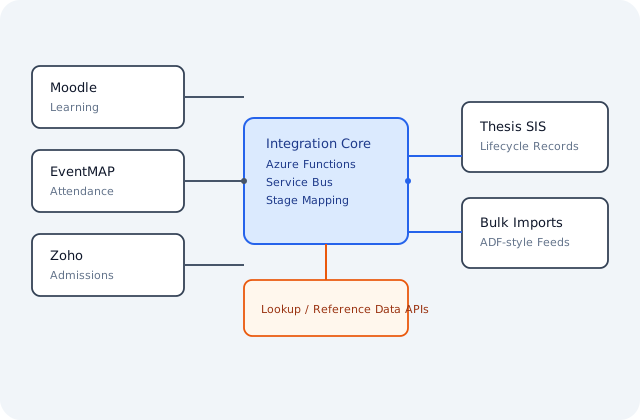
The integration layer synchronized four purpose-built platforms plus bulk source feeds.
Staged workflows supported large imports alongside event-driven updates.
Asynchronous orchestration allowed processing stages to recover without restarting the complete flow.
Challenge
A UK-based education and banking services group operated multiple open-source and enterprise systems across student lifecycle management, including:
- Moodle (Learning Management System)
- EventMAP (Timetabling, scheduling, attendance)
- Thesis (Student Information System)
- Zoho (Admissions / CRM workflows)
- Bulk data ingestion pipelines (ADF-style processing)
These systems served different purposes:
- Courses and learning -> Moodle
- Attendance and scheduling -> EventMAP
- Academic records and lifecycle -> Thesis
- Admissions and engagement -> Zoho
However, they were not natively integrated.
This led to:
-
Fragmented student lifecycle Student data, attendance, academic status, and group/class changes were spread across systems without synchronization.
-
Manual reconciliation Teams had to manually align data between systems, increasing operational overhead and risk of errors.
-
Delayed updates Critical updates such as attendance, status changes, or group promotions were not reflected in real time across platforms.
-
Inconsistent data Different systems could hold conflicting views of the same student.
-
Lack of scalable integration Point-to-point integrations were not sufficient to handle volume and complexity.
Approach
Kindl Labs designed and implemented a modular, Azure-based integration platform to connect all systems through a structured and scalable architecture.
Key design principles:
- Decoupled system integration
- Event-driven and batch processing
- Staged data transformation
- Reusable mapping and lookup services
- Operational visibility and resilience
Core engineering approach:
- Central staging and processing pipeline A structured import-processing framework was introduced to manage data through multiple stages:
- Extraction
- Mapping
- Upload
- Completion
- Azure Functions-based integration layer Multiple timer-triggered and event-driven Azure Functions handled:
- data extraction
- transformation
- system synchronization
-
Service Bus for asynchronous orchestration Azure Service Bus was used to decouple processing stages and enable scalable, parallel execution.
-
Canonical mapping layer Stage-based mappers converted source data (Moodle, EventMAP, Zoho) into target-compatible payloads for Thesis and other systems.
-
Lookup and reference services Dedicated lookup APIs ensured consistent mapping of reference/master data across systems.
-
Multi-system synchronization Updates were propagated across:
- Moodle (group updates, academic status)
- EventMAP (attendance, scheduling)
- Thesis (core student lifecycle updates)
- Zoho (admissions and engagement updates)
- Batch and real-time support The platform supported both:
- scheduled batch processing (large datasets)
- near real-time updates (event-driven)
Solution Architecture
This architecture connected LMS, SIS, CRM, and attendance systems through staged processing and asynchronous orchestration.
                 +----------------------------------+
                 |    ADF / Bulk Data / Source Feeds|
                 +----------------+-----------------+
                                  |
                                  v
                 +----------------------------------+
                 | Import Processing / Staging Layer|
                 +----------------+-----------------+
                                  |
                                  v
                 +----------------------------------+
                 |     Stage 1 Mapping Services     |
                 | (Canonical Transformation Layer) |
                 +----------------+-----------------+
                                  |
                                  v
                 +----------------------------------+
                 |       Azure Service Bus          |
                 |   (Async Orchestration Layer)    |
                 +--------+-----------+-------------+
                          |           |
                          v           v
        +----------------------+   +----------------------+
        | Thesis API Handler   |   | Moodle / EventMAP    |
        | (Stage 2 Processing) |   | Sync Functions       |
        +----------+-----------+   +----------+-----------+
                   |                          |
                   v                          v
        +----------------------+   +----------------------+
        |     Thesis SIS       |   |  Moodle / EventMAP   |
        +----------------------+   +----------------------+
                   |
                   v
        +----------------------+
        | Zoho Update Results  |
        +----------------------+

        +---------------------------------------------+
        | Lookup APIs / Config / Management App       |
        +---------------------------------------------+
Outcome
The platform transformed a fragmented system landscape into a unified, scalable student operations backbone.
Key results:
-
Unified student lifecycle Data across Moodle, EventMAP, Thesis, and Zoho became synchronized and consistent.
-
Reduced manual effort Manual reconciliation between systems was significantly reduced.
-
Improved data consistency Single-source-of-truth behavior was achieved through controlled synchronization.
-
Scalable processing The architecture supports:
- high-volume batch processing
- parallel execution
- future system integrations
-
Faster operational updates Attendance, group changes, and status updates propagate across systems with minimal delay.
-
Resilient integration
- Retry mechanisms
- Staged processing
- Failure isolation
Technologies
- C#
- .NET
- Azure Functions
- Azure Service Bus
- REST APIs
- SOAP/XML (where applicable)
- Moodle APIs
- EventMAP APIs
- Thesis APIs
- Zoho APIs
- In-memory / staged processing
- Lookup / reference services
- Batch processing patterns
Testimonial
“Kindl Labs helped us unify multiple systems into a single, reliable integration platform. The solution significantly improved operational efficiency and data consistency across our academic processes.”
From proof to your next decision
See the capability demonstrated in this engagement and the thinking behind the approach.
Data & Integrations
Connect systems, improve visibility, and make data more useful.
Explore the service Related perspectiveWhy Enterprise Integrations Break Down at Scale
Most integration failures are architectural, not technical. Point-to-point connections compound quietly into systems that are hard to diagnose, change, or operate reliably.
Read the insightDiscuss a similar challenge with the team behind our data & integrations work.
Start a conversation